The short answer
Resin-bound offers a seamless finish, low weed growth and minimal maintenance; block paving offers easier local repair, a classic appearance and potentially longer lifespan when well maintained. The right choice depends on your priority: resin is typically lower-maintenance; block paving is easier to repair and can be lifted for utility access. See resin vs block paving cost for the price comparison.
Block paving and resin-bound surfacing are the two premium-positioned options for UK residential driveways, and they are often quoted against each other. Both can look excellent, both can last 15–25 years, and both sit at a similar price point. The real differences are in maintenance demands, repairability, and how they handle the long-term risks of weeds, root movement and utility access.
Resin vs block paving at a glance
- Weed growth Resin: minimal; Block paving: joints require management
- Local repair Resin: visible patch; Block paving: individual brick replacement
- Utility access Resin: difficult; Block paving: bricks can be lifted & relaid
- Lifespan Both: 15–25 years; block paving up to 40 years if relaid
- Colour choice Both: wide range
- Permeability Both available in permeable versions
Appearance and design
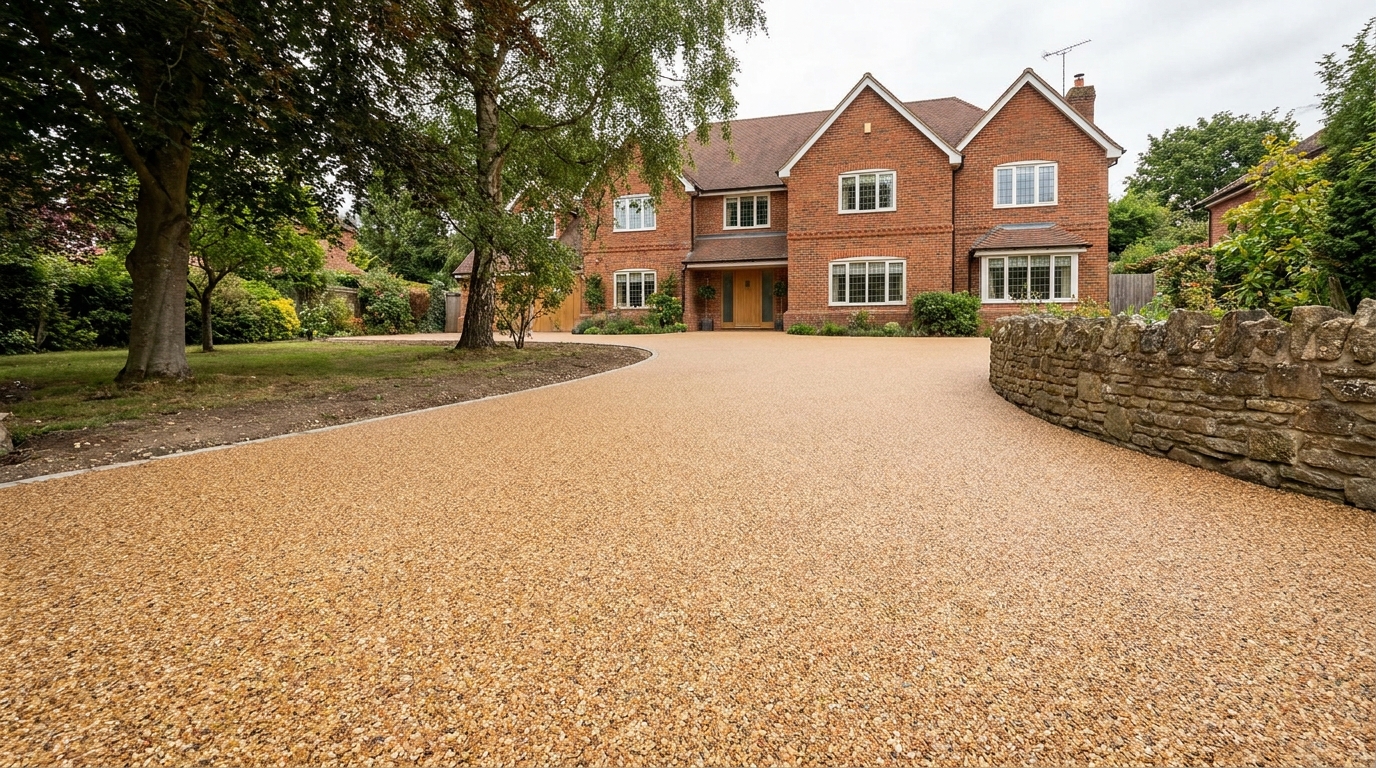
Both materials offer a wide range of colours and styles. Resin-bound surfacing gives a smooth, seamless surface with no joints, which suits contemporary house styles and flows easily around curves, steps and edging details. Block paving gives a jointed, brick-laid appearance that suits both traditional and modern properties and can be laid in herringbone, basketweave or stretcher bond patterns. The seamless quality of resin-bound is an aesthetic advantage for some homes; the patterned, textured appearance of block paving suits others. Neither is objectively superior — it is a matter of the property style and the homeowner’s preference.
Maintenance: resin’s biggest advantage
Block paving has jointing sand between the bricks that weeds colonise and that washes out over time and needs replacing. On a large driveway, regular weeding, weed-killing, periodic kiln-dried sand restabilisation and occasional re-laying of settled bricks is a meaningful and ongoing maintenance commitment. Resin-bound has none of these joint-related issues: there is nothing between the stones for weeds to colonise. Annual pressure-washing and a biocide treatment for shaded areas is typically all that is needed. For homeowners who want to minimise maintenance, resin-bound has a clear advantage. See resin driveway maintenance.
| Criterion | Resin-bound | Block paving |
|---|---|---|
| Joint weeding | Not needed (no joints) | Ongoing — annual treatment |
| Sand restabilisation | Not needed | Every 3–5 years |
| Annual cleaning | Pressure-wash & biocide | Pressure-wash, weed treat, re-sand |
| Local repair | Visible patch | Lift, fix base, relay bricks |
| Utility access | Disruptive, patch visible | Lift bricks, relay — seamless |
Repairability and longevity
Block paving’s biggest practical advantage is local repairability. A single subsided or cracked brick can be lifted, the base adjusted and the brick replaced or substituted with an identical one from the same batch (or a close match). Over decades, this means block paving can be maintained indefinitely: sink a few bricks, relay them; frost damage, replace the affected bricks. Well-maintained block paving can realistically last 30–40 years. Resin-bound, by contrast, is difficult to repair invisibly: colour-matching a patch laid years after the original batch is hard, and patches are usually detectable. When a resin-bound driveway reaches the end of its life, the whole surface typically needs resurfacing at once.
When to choose each material
Choose resin-bound if: minimal ongoing maintenance is the priority, the property benefits from a seamless contemporary look, tree roots are not a risk, and there are no utility chambers under the drive that are likely to need access. Choose block paving if: easy local repair is important, you have utility chambers under the driveway, or you want a classic appearance that can be maintained for 30–40+ years. Both are valid for front driveways in England when specified in a permeable version, satisfying planning rules. This is general information, not professional advice; always get written quotes for both materials for your specific property.
Frequently asked questions
Does block paving last longer than resin?
Block paving can last 30–40 years with ongoing maintenance and periodic relaying; resin-bound typically needs resurfacing after 15–25 years. Both depend heavily on base quality and care.
Is resin driveway easier to maintain than block paving?
Yes, day-to-day. No joint-weeding, no sand restabilisation and no individual brick replacement. Annual pressure-washing and biocide is the main routine.
Can block paving be converted to resin?
Yes, if the blocks are stable and level. An installer will assess whether the existing block paving base can carry a resin overlay or whether it needs adjustment.
Which is better for house value — resin or block paving?
Both quality options improve kerb appeal. The better value choice is the one that suits the property style and the buyer demographic in your area. No specific uplifts can be stated as they vary by market.
Sources & further reading
- Pavingexpert — comprehensive comparison of resin-bound and block paving for residential driveways
- BALI — British Association of Landscape Industries on hard-landscaping materials and standards
- GOV.UK — planning guidance on permeable driveways and householder permitted development
- CIRIA — SUDS manual on permeable block paving and resin-bound paving design
This is general information, not a site-specific survey, quote or professional advice. Prices, timescales and outcomes vary with your ground conditions, drainage and chosen installer. Always obtain a written quote and check the installer before committing.