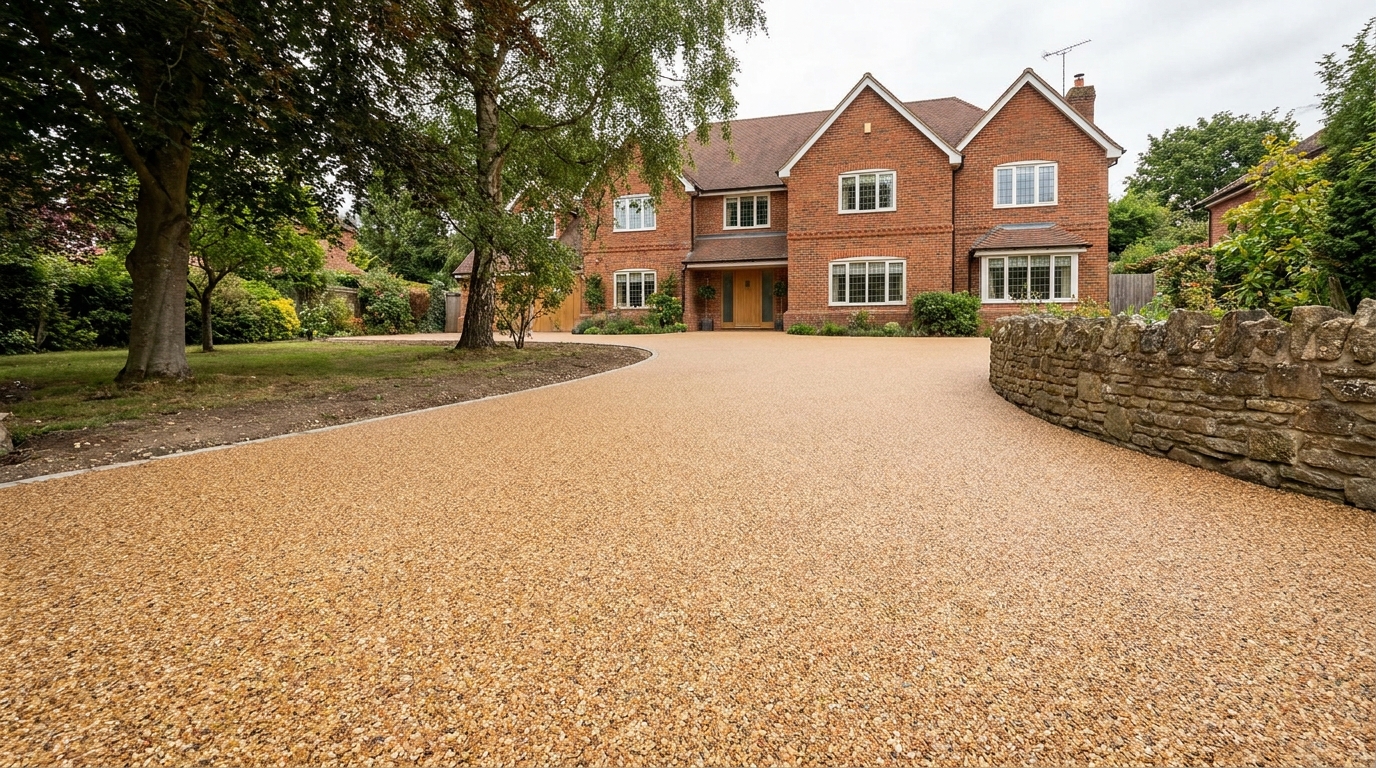
The short answer
Resin-bound driveways are permeable, low-maintenance, long-lasting and available in a wide colour range — but they are relatively expensive upfront, depend heavily on base quality and can crack if installed over a failing sub-base. For most UK homes the advantages outweigh the drawbacks, but the quality of the installation matters more than almost any other factor. See how to choose a resin driveway installer before committing.
Resin driveways are often presented in marketing material as a near-perfect product. They have genuine advantages, but they also have real limitations that matter when you are spending £3,000–£10,000+ on a driveway. This guide sets out both sides honestly, drawing on Pavingexpert’s technical guidance and the experience of qualified landscaping contractors, so you can make an informed decision rather than one based on promotional photography.
Pros and cons at a glance
- Top advantage Permeable — qualifies under SUDS rules without planning
- Second advantage Low maintenance — no weeding, no loose stone
- Top disadvantage Upfront cost — typically £50–£100+ per m²
- Second disadvantage Base-dependent — cracks telegraph up from below
- Lifespan 15–25 years when well installed
- Key risk factor Installer quality and base preparation
The genuine advantages
Resin-bound surfacing offers several benefits that set it apart from concrete, block paving and tarmac in the UK residential context:
- Permeable — SUDS compliant: rainwater drains through the surface, satisfying the Government’s SUDS rules for front driveways and meaning planning permission is not usually needed in England.
- Low day-to-day maintenance: there are no joints to weed, no stones to rake back, and no moss growing in cracks — a leaf blower and an occasional biocide wash are usually sufficient.
- Wide aesthetic range: 20–50 aggregate colours and blends, with seamless curves and custom edging possible, giving a finish difficult to achieve with any other material.
- Durable wearing surface: a well-installed system on a sound base will withstand normal domestic vehicle traffic for 15–25 years without the surface itself needing replacement.
- No loose stones: because the aggregate is fully bound, there is nothing to scatter onto flowerbeds or be thrown by tyres, making it safer than gravel near windows and neighbouring properties.
- UV-stable when correctly specified: quality UV-stable polyurethane resins resist yellowing and colour bleaching from sunlight better than older acrylic or epoxy systems.
The genuine disadvantages
Being honest about the limitations is just as important:
- Higher upfront cost: at £50–£100+ per m² installed, resin-bound is one of the more expensive driveway materials. A 50 m² drive might cost £3,000–£5,000 or more depending on base work and complexity. See resin driveway cost for the ranges.
- Entirely dependent on the base: resin is a thin wearing course, not a structural layer. If the tarmac or concrete base beneath is cracked, saturated or too thin, those faults will show through or cause the resin to fail early.
- Can crack over tree roots or movement: ground movement from roots, frost heave or differential settlement will crack resin-bound as surely as it cracks concrete. See do resin driveways crack? for the causes.
- Not DIY-friendly: the mix ratios, timing window and equipment requirements (forced-action mixer, specialist trowels) mean that amateur installation rarely achieves a good result; most failures trace back to DIY or low-skill contractors.
- Algae and moss in shade: north-facing or heavily shaded areas can develop moss and algae patches, though periodic biocide treatment controls this. See resin driveway maintenance.
- Difficult and costly to repair invisibly: localised repairs are visible as patches because batch-mixing exact colour matches is near-impossible without the original supplier’s product.
| Feature | Resin-bound | Block paving | Tarmac |
|---|---|---|---|
| Permeable | Yes | With permeable blocks | No (usually) |
| Lifespan | 15–25 yrs | 20–40 yrs | 15–25 yrs |
| Weeding | Minimal | High (joint sand) | Low |
| Colour choice | Wide | Wide | Limited |
| Cost per m² | £50–100+ | £25–60 |
Is a resin driveway worth the money?
For most UK homeowners with a reasonable base condition and a front drive that gets daily use, the combination of low maintenance, attractive finish and SUDS compliance makes resin-bound good value over a 15–25 year life, even at £50–£100+ per m². The calculation changes if the existing base is in poor condition: significant base repair adds to the cost, and it is worth comparing the total figure against a fresh tarmac or block-paving installation. Always get at least three written quotes specifying the resin system, aggregate, base treatment and depth so comparisons are honest. This is general information, not site-specific professional advice; a written quote from a qualified installer is always necessary before committing.
Frequently asked questions
Do resin driveways crack?
They can, usually because the base underneath has moved or failed rather than because the resin itself is faulty. A sound, well-compacted base dramatically reduces the risk. See do resin driveways crack?
Are resin driveways slippery when wet?
A properly installed resin-bound surface has a slip-resistance rating suitable for pedestrians and vehicles. The texture of the aggregate provides grip. See are resin driveways slippery?
Do resin driveways add value to a home?
A neat, permeable driveway generally improves kerb appeal and can support property value, particularly in urban areas where off-street parking is at a premium. No specific uplift figure can be guaranteed.
Can I lay resin over my existing driveway?
Often yes, if the existing surface is structurally sound, flat and properly bonded. Cracked or weak areas must be repaired first. See can you lay resin over concrete?
Sources & further reading
- Pavingexpert — technical guides on resin-bound surfacing, base preparation and failure modes
- BALI — British Association of Landscape Industries quality standards for resin surfacing
- GOV.UK — Householder planning guidance on driveways and permeable surfaces
- CIRIA — SUDS manual, permeable paving design and permeability standards
This is general information, not a site-specific survey, quote or professional advice. Prices, timescales and outcomes vary with your ground conditions, drainage and chosen installer. Always obtain a written quote and check the installer before committing.